
UXQCC Certified Professional in Software Usability with GenAI – Foundation Level (UXQCC GenAI)
Software Usability with GenAI
The essential usability fundamentals for software teams — in as little as one or two days
You do not need to become a UX specialist to make software more usable.
The UXQCC GenAI Foundation Level teaches the focused fundamentals software teams need to identify usability risks, use GenAI effectively, improve software artifacts, and recognize when real users or UX specialists are needed.
The syllabus has been developed with input from experts from academia, teaching and industry and is designed for practical use in software development.
With some prior knowledge, the essentials can be covered in a one-day workshop. The full certification training takes 16 hours.
16 h certification training | 60 min exam | 40 questions | 65% to pass | English & German

WHY NOW
AI has made creation faster.
Judgment has become the bottleneck.
GenAI can generate requirements, interfaces, code and tests in minutes. The result may look complete and professional — and still be wrong for the actual users, their tasks or their context.
Software teams therefore need a new capability: not simply generating more output, but knowing what to question, what to verify and when real users, domain experts or UX specialists are required.
THE CORE PRINCIPLE
AI is strong with familiar patterns.
It is weak with unfamiliar context
AI is remarkably strong with familiar patterns and much weaker with unknown context. Software engineering already uses AI extensively, so developers know this effect well.
AI can generate convincing code, architectures, tests or UI components in seconds, but it cannot know the specific constraints, users and real-world conditions of a particular system unless we provide them. The same applies to usability. AI can contribute patterns and structure; the team still has to contribute the context and make the decisions.
Who is this certification for?
The UXQCC GenAI Foundation Level is designed for professionals involved in the specification, development, evaluation and improvement of software products. Typical target groups include:
Software Development & QA
Software Developers
Frontend Developers
Testers & QA Professionals
Product & Requirements
Product Owners & Product Managers
Requirements Engineers
Business Analysts
UX, Design & Team Leadership
UX & UI Professionals
Scrum Masters & Agile Coaches
Team Leads & Engineering Managers
ESPECIALLY RELEVANT IF …
- Your team already uses GenAI for requirements, design, code, testing or analysis, but usability is not yet systematically integrated into the development process.
- No UX specialist permanently available? That is exactly the situation this certification is designed for.
- The goal is not to turn software developers into UX specialists. It is to build enough usability competence within the team to recognize problems, make better decisions and know when specialist expertise is required.
Software Usability is one of the few software-quality improvements where small interventions early in the process can prevent disproportionately large costs later.
Software Usability can be built into the development process you already have.
Improving usability does not require adding a parallel development process. Instead, usability-related activities can be integrated at the points where your team already makes decisions: discovery, backlog refinement, planning, implementation, reviews, testing and monitoring.
The key is to add the right usability steps at the right moment — for example, a usability requirement, a better acceptance criterion, a missing system state, a short usability check, or one real user completing a task. Small additions like these can prevent expensive rework, support effort and avoidable user errors later.
Competence Profile and Learning Objectives
Download the complete competence profile for the UXQCC GenAI Foundation Level, including all Business Outcomes and Learning Objectives. The document provides a concise overview of the competencies covered by the certification and is available in English and German.
THE SYLLABUS
From discovery to release: usability throughout software development
The syllabus follows the work of a software team rather than a traditional UX curriculum. Nine modules connect usability and GenAI with the decisions teams already make throughout development.
01
Usability and AI
Understand usability as part of software quality — and where GenAI helps, where it misleads and what remains a human responsibility.
02
Usability Foundations
Build the human-factors and usability knowledge needed to assess requirements, interfaces and AI-generated results.
03
Discovery
Understand users, goals, tasks and context. Structure existing evidence and turn it into testable hypotheses instead of assumptions.
04
Backlog Refinement
Turn usability findings into usable backlog items. Reveal implicit requirements, strengthen user stories and add testable acceptance criteria.
05
Planning and Teamwork
Make usability work visible in planning. Clarify responsibilities, schedule lightweight activities and know when specialist expertise is needed.
06
UI, Information Architecture and States
Assess navigation, prototypes and AI-generated interfaces. Identify missing states, edge cases and interaction paths before they reach the code.
07
Code, Components and Accessibility
Review AI-generated frontend code, components and handoffs. Check system feedback, error handling, keyboard operation, semantics and accessibility.
08
Evaluation, Testing and Validation
Use heuristic evaluation, cognitive walkthroughs and usability tests. Distinguish AI-generated findings from evidence based on real user observation
09
Release, Monitoring and Improvement
Use feedback, support tickets and usability metrics after release. Identify patterns, UX debt and improvement opportunities and feed them back into development.
9 modules · one development path
From understanding the problem to requirements, implementation, validation and continuous improvement.
Certification examination
The examination verifies whether candidates understand the foundations defined in the syllabus and can apply them to typical situations in software development.
It particularly assesses whether candidates can critically review AI output, recognise the limits of AI, and consider usability-related aspects in discovery, requirements, backlog items, UI drafts, prototypes, code, tests, reviews, and monitoring.
Exam Facts
- 40 multiple-choice questions
- Four answer options per question
- Exactly one correct answer
- 60 minutes
- 65% required to pass
- 26 of 40 points (65%)
- No negative marking for wrong anwsers
- 30 questions at K1/K2 level
- 10 questions at K3 level
- An additional 15 minutes may be granted when the candidate’s native language differs from the examination language
Official syllabus and exam preparation documents
The official documents are publicly available in English and German. The mock examination contains both the examination questions and a separate answer and commentary section.
Syllabus
UXQCC Certified Professional in Software Usability with GenAI – Foundation Level
Syllabus · English · Release Version 1.0 · August 2026
Mock Exam A
UXQCC Certified Professional in Software Usability with GenAI – Foundation Level
40 questions · Answer key included · English
Exam Regulations
UXQCC Certified Professional in Software Usability with GenAI – Foundation Level
English · Version 1.1 · July 2026
Syllabus
UXQCC Certified Professional in Software Usability with GenAI – Foundation Level
Syllabus · German · Release Version 1.0 · August 2026
Mock Exam A
UXQCC Certified Professional in Software Usability with GenAI – Foundation Level
40 questions · Answer key included · German
Exam Regulations
UXQCC Certified Professional in Software Usability with GenAI – Foundation Level
German · Version 1.1 · July 2026
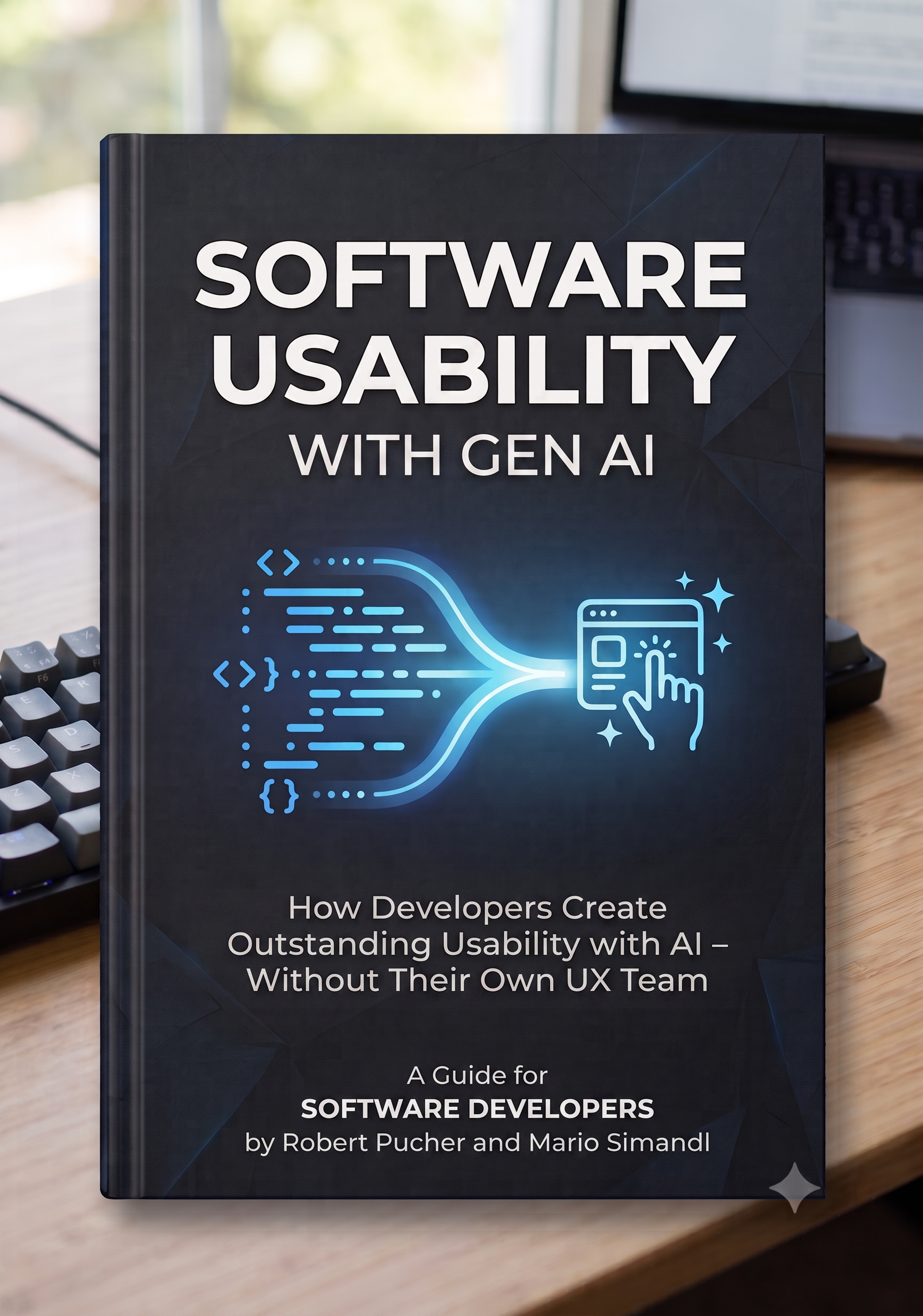
Practice book aligned with the UXQCC GenAI syllabus
Software Usability with GenAI
How developers can create outstanding usability with AI — without a dedicated UX team
Robert Pucher & Mario Simandl
Publication date:
German edition: November 1, 2026
English edition: January 1, 2027
This practice-oriented companion book shows software development teams how Generative AI can support usability work throughout the development process — even when no dedicated UX role is available.
Rather than focusing on short-lived AI tools, the book develops the human knowledge and judgement needed to use AI effectively: understanding user problems, improving requirements, evaluating generated interfaces and code, conducting pragmatic usability tests and using operational data for continuous improvement.
The book covers:
- building practical usability knowledge with GenAI
- identifying real user problems from existing project data
- turning usability needs into testable backlog items and acceptance criteria
- critically evaluating AI-generated interfaces and code
- conducting lightweight usability tests without a UX lab
- measuring improvements and managing UX debt after release
The book follows the subject structure of the UXQCC GenAI syllabus, but is independently authored and is not official examination preparation material.
German edition: November 1, 2026 · English edition: January 1, 2027
Training providers
Deliver accredited UXQCC GenAI training
The UXQCC GenAI Foundation Level creates a new training opportunity for organisations and professionals working in software engineering, software quality, product development, UX, and professional education.
Accredited training providers deliver official preparation courses aligned with the business outcomes and learning objectives of the syllabus. They receive additional resources designed to support consistent, practical, and professionally reviewed training.
Provider resources available
Quality statement
- extended provider edition of the syllabus
- official base slide set
- didactic guidance
- practical exercises
- supporting prompt examples
- materials for training preparation and quality assurance
Accredited training must cover more than individual AI tools or prompt demonstrations. It must address software usability, the limits of AI, human review, data protection, accessibility, governance, code quality, testing, and validation.
Looking for training — or interested in offering it?
Find an accredited provider for UXQCC GenAI training, or learn how your organisation can become an Accredited Training Provider.
Clear responsibilities ensure credible certification
UXQCC
Develops and maintains the certification scheme, syllabus, business outcomes, learning objectives, provider requirements, and quality framework.
Accredited training providers
Deliver professional preparation courses using approved materials and methods aligned with the official syllabus.
GASQ
Administers the official certification examinations — online or on-site.